
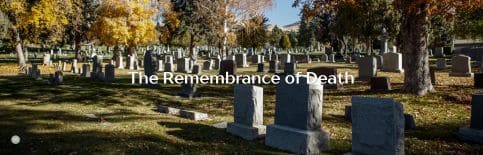
It was encouraging to see the response to last week’s column about the passing of Ted Turner. The Christian classics so emphasize the importance of the remembrance of death as a spiritual discipline that I want to take the next two weeks to post a little more about it. The remembrance of death is rarely talked about in contemporary circles, but the classics stressed it to such a degree that I believe we cannot live a fully obedient and fruitful life without it. See if you agree.
FYI, this is an excerpt from my very first book, which was re-released as Thirsting for God.
Living in a Dying World:
The Remembrance of Death
When sportscaster Glenn Brenner died at the age of 44 in Washington DC, the city was in shock for several days. Why? After all, the city had been dubbed the murder capital of the United States, and victims of violent crime die there virtually every day—sometimes a half-dozen a night. Yet radio talk-show hosts devoted entire mornings or afternoons to Brenner’s death. The newspaper covered it in every issue for a week. One television station ran a half-hour memorial program.
The city was stunned by the suddenness of the death. It forced people to remember that death doesn’t always wait until we’re 95. Sometimes it sneaks up on us in our forties. As people called talk shows to express their shock, they repeated a familiar refrain: “It was so sudden; so unexpected. He was so young, in such good health, and then all of a sudden…I just can’t believe it.”
Brenner had recently completed a marathon. He was young, healthy, humorous, and successful, but all of that became irrelevant when a brain tumor took his life. Death didn’t take into account his cardiovascular capability. It didn’t inquire about the number of children still depending on him or his vocational success or how beloved he was in the capital city. Death doesn’t ask questions; it doesn’t review résumés. It just comes.
The city was unsettled by death’s rude intrusion into its life. Denial was no longer possible, and people were forced to consider that maybe there’s more to life than we have been told. Maybe we need to make some inquiries and answer a few questions before death comes to knock on our door.
Every now and then we sneak a peek at the obituaries and look at the ages of those who have died. When we see somebody our own age or even younger, we involuntarily wince. We grope for the cause of death—please don’t let it be a heart attack or cancer, we hope. We want to be immune from that, at least for now.
Our denial means nothing to death because death doesn’t have to ask our permission. Death is coming. Every day is somebody’s last.
Continue reading this blog on Substack HERE.
Leave a Reply