

Nobly born, wealthy, well-married, and a young mother, Vibia Perpetua typified the ideal of a successful North African woman at the dawn of the third century. Her Christian faith, however, soon turned her idyllic existence into a battleground of alienation when Emperor Septimus Severus announced a decree forbidding conversion to Christianity—and requiring all citizens to offer sacrifices to him, as if he were a god. Those who refused would be thrown to the beasts at the amphitheater for entertainment.
Perpetua made it known that as a follower of Jesus Christ she would not, could not offer sacrifices to the emperor. Her father, beside himself, tried vainly to convince his 22-year-old daughter not to “throw her life away.” He pleaded with her not to bring shame onto him, nor to abandon her child, who was still nursing. Was it really that big of a deal, he asked, to make such a small ceremonial sacrifice?
Perpetua pointed to a ceramic pitcher. “Father, do you see this pitcher?”
“Yes, of course I see it.”
“Can it be called by any name other than what it is?”
“No.”
“So I also cannot be called anything else than what I am, which is a Christian.”
In her diary, Perpetua tells us that, “Enraged by my words, my father came at me as though to tear out my eyes.”
She escaped violence—that time. But on March 7, 203, Perpetua, accompanied by her servant Felicity, entered the amphitheater to face a gruesome death. The young women were stripped naked, but even this bloodthirsty crowd could not bear such a sight. A medieval sourcebook describes the crowd’s horrified reaction: “The people shuddered, seeing one a tender girl, the other her breasts yet dropping from her late childbearing. So they were called back and clothed in loose robes.”
With focused malice, the young women’s executioners chose a bull heifer. Unlike a bear or lion, which often killed their prey with one swipe of a paw, a bull’s killing took time—death by a dozen gores, so to speak. And so, the bulls went to work. After yet another mauling that left the young women torn but not dead, the crowd appealed to the emperor, “Enough!” Even a violence-craving crowd that came specifically to see Christians being torn apart as “entertainment” could take only so much.
The emperor gave the order and a gladiator came out. He was supposed to behead the women, but as he walked up to Perpetua, the hardened killer’s hands started to tremble. Perhaps it was something in Perpetua’s face, something about her eyes—who knows?—but the distracted gladiator’s first blow further injured, but did not kill, the young martyr.
This gladiator’s life had depended on killing strong, trained, and fierce opponents with one blow, lest he be killed himself. Yet when he stood in front of an unarmed, twenty-two-year-old Christian woman who had never held a sword in her life, he stopped short of killing her.
The crowd became sick to their stomachs. Perpetua saw their pain and showed them all mercy by clutching the gladiator’s hand and guiding his sword to her neck. She was so filled with love that she felt sorry for the blood-thirsty crowd who came solely to see her grotesque execution, and she moved to lessen their pain by helping the failing gladiator to finish his job.
God used Perpetua’s courage and love to energize the church just before it entered a terrible season of persecution. Excepting our Lord Himself, have courage and love ever been more gloriously joined than in this young woman? Her story so inspired the early church that warnings often went out not to treat her diary (widely circulated) like Scripture. No less a light than St. Augustine annually preached sermons in Perpetua’s honor on March 7, the anniversary of her death. Many more Christians would die, but they would do so with Perpetua’s example lighting their way, responding to hate with love, and to violence with compassion.
Kissing the Lepers
When a then 24-year-old Francis of Assisi gave up his family’s fortune to follow Christ, he sensed God telling him, “Francis, all those things that you have loved in the flesh you must now despise, and from those things that you formerly loathed you will drink great sweetness and immeasurable delight.”
A son of affluence living in an age of opulence (for church leaders, anyway), Francis took application seriously. As he pondered these words he asked himself what he used to despise most.
The answer was easy: lepers.
It is difficult for most moderns to understand the terror of that once untreatable disease. Leprosy is an insidious malady in which bacteria seek refuge in the nerves and then proceed to destroy them, one by one. Since the bacteria prefer the cooler parts of the body, toes, fingers, eyes, earlobes, and noses are most vulnerable. When your nerves lose all sensitivity, you become your own worst enemy, not realizing the damage you’re causing to your own body. You could literally rub your eyes blind or leave your hand in a fire.
Eventually, you lose your ability to see, and then you lose your ability to feel, and suddenly, you’re living in a senseless world. The only way to know what you’re holding in your hands is to find any remaining, stubbornly sensitive part on your body—perhaps a quarter inch stretch of your lips, or a half-inch spot on your cheek—and try to guess from the texture and the weight what it is that you’re carrying.
Even apart from the macabre appearance of a leprosy victim, no one wants to end up alienated from the world, so most people kept an understandably wide berth around lepers. It was one of the most feared diseases of its time. “During my life of sin,” Francis wrote, “nothing disgusted me like seeing victims of leprosy.”
Exuberant in his newfound faith and with joy flooding his soul—and remembering that he was now to love and even treasure those things that he formerly loathed—Francis chose not to run from the leper he passed on the side of the road, as he would have earlier in his life. Instead, he leapt down from his horse, knelt in front of the leper, and proceeded to kiss the diseased-white hand.
He kissed it.
Francis then astonished the leper by giving him money. But even that wasn’t enough! No, Francis was determined to “drink great sweetness” from what he formerly loathed, so he jumped back on his horse and rode to a leper colony. Francis “begged their pardon for having so often despised them,” and after giving them money, refused to leave until he had kissed each one of them, joyfully receiving the touch of their pale, encrusted lips. Only then did Francis jump back on his horse to go on his way.
This act was a grotesquely gorgeous parable of a radically changed man. The very instant that Francis’ lips touched the leper, what could have been merely a personal religion gave way to the weight of a sacrificial life. The horse no longer carried a man; that beast transported a saint whose example confronted the opulence of the 13th century church in Italy, called her back to a purer faith in Christ, and continues to inspire us today.
If you want to apply this today, ask yourself who you and your peer group most tend to despise and look down on, and then ask God how He wants you to prophetically respond to that group in the future. Where the world responds with prejudice, apathy and hatred, how can you shine the light of Christ and His love?
We Need Young Women and Men
Young people have a lot of passion; the key is to funnel that passion in the right direction. Perpetua and Francis were known by what they were for, not for what they were against. They understood the current evil–Francis was appalled at the rampant materialism of his day—but instead of picketing the Vatican, he modeled the attraction of a simple life, walking without shoes, refusing to take the title of “priest.” It’s the same thought behind Martin Luther King Jr.’s famous quote, “Hate cannot drive out hate; only love can do that.”
The “end goal” may often be the same, but getting stuck on outrage or cancel culture without latching on to the beauty of the alternative, and practicing that love-based alternative in a prophetic way, is the way of Christ.
Let me stress: I am not telling anyone how to confront today’s injustices. I am instead inviting young adults to lose themselves in service to the majestic, powerful, lovely and glorious Christ who so captured the affection of Perpetua and Francis that earthly comforts could not compete with their heaven-sent passion.
Young people won’t—and shouldn’t—give their lives for a set of rules or prohibitions. God’s work has been built on the church representing a glorious passion for something even better than the best this world has to offer. Their roles, giftings and callings must be respected. They won’t wait. They won’t. They want to serve now. And if they can’t serve the church now, they’ll find something else to serve.
In their early twenties, Perpetua and Francis would be considered part of the “youth adult ministry” by church leadership today, yet both of them prophetically inspired and redirected the church—Perpetua in a time of persecution, Francis in a time of affluence. The Holy Spirit equips young believers in every generation to face the particular socio-political crisis of that generation’s time. We can thus be certain He’s calling out to young people today, right now. I just pray young adults are listening. The church needs your passion and service, even if certain elements within the church may seem to put roadblocks in your way. Like Perpetua and Francis, you may end up disagreeing with older adults in pursuit of your faith.
If you’re one of these young people, you realize how uninspiring it is to give yourself to a limited Christianity that is primarily about your own salvation after you die. Praying the “sinner’s prayer” is the beginning, not the end of your faith. Jesus said to continually keep putting His kingdom first over your own (Matt. 6:33). Paul said that Christ died for all so that those who “live might no longer live for themselves but for him who for their sake died and was raised” (2 Cor. 5:15). Throughout history, God has taken formerly selfish, narcissistic individuals who once lived only for themselves, and transformed them into prophets of compassion, wisdom and inspiration. Perpetua left a life of luxury to face the gladiator; Francis walked away from a fortune and gave his money to the lepers. The older we get, the more difficult it is to live such inspiring lives. Young people can call us back to what truly matters.
Regardless of our age, if we are believers, our clear “marching orders” from Jesus are to seek first the Kingdom of God (Matt. 6:33). First. There are many good causes out there, but will we embrace the greatest one? Has our faith become all about us—our temptations, our prayer requests, our family, our world—or is it becoming enlarged enough to embrace and to care about all that God is doing? The path to true fulfillment comes from dying to our own world and being reborn to live for another. Now in eternity, does anybody think either Perpetua or Francis regret their passionate pursuit of God’s kingdom while they lived on this earth? In the same way, those of you who serve God from the time you are young will never regret the years of sacrifice of service.
God wants to take the unique you—your gifts, background, weaknesses, hurts, limitations—and use them to express his transforming power to change the world through a radically imperfect person. What could be more exciting than that? What, at the end of our lives, could we ever think would be worth half as much as giving ourselves over to this?
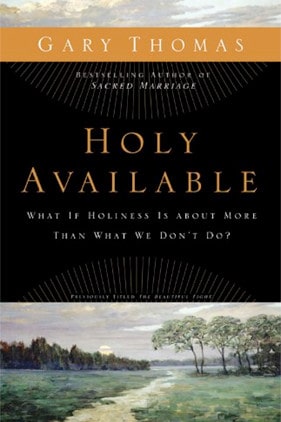
Gary tells more of Perpetua’s and Francis’ stories in his book Holy Available.