

The following characteristics are essential to make a marriage. You can’t expect a twenty-two-year-old to possess all of them in their full mature form, but you should see the foundations of these elements. The degree to which they are not present is the degree to which you’ll have difficulty building intimacy with this person and the degree to which you’re going to struggle in the early years of marriage. If you’ll accept this premise, it’ll go a long way toward helping you make a wise marital choice: a good marriage isn’t something you find, it’s something you make. That being said, look for a spouse who:
IS HUMBLE
A quick definition: humility is not thinking less of yourself, it is thinking less about yourself. It is someone who, like Jesus, believes he has come “not to be served, but to serve.” Jesus knew His talents, and He knew His deity, but He used His power to serve. Unlike Jesus (since we are not perfect, and He was), a humble person is someone who has experienced and is experiencing conviction of sin: they are aware that they fall short, every day, and that they have much to work on, and biblical grace is the only place they put their hope.
The only thing worse than marrying an imperfect person is marrying an imperfect person who thinks he or she is perfect. When you lovingly confront them, they’ll take offense. Or, horrified that they’ve been found out, they’ll minimize the issue with silly games: “I’m just a horrible, horrible wife.” No, you’re a good wife who has a sinful issue that needs attention. The reason I call this a “game” is that unparticular repentance is a clever way to avoid particular conviction. Saying “everything about me is rotten” helps us sidestep the fact that some parts of us are more rotten than others.
While theologically it is true that “all our righteous acts are filthy rags,” that doesn’t mean we don’t have some strengths and weaknesses. A wise person knows he might excel at giving but lack patience, or excel in patience while lacking courage. The key is to accept that there will always be weaknesses in our lives and, with a spirit of willingness and appreciation, to learn to value a spouse who wants to help us make every effort to add to our faith (2 Peter 1:5–7).
Humility matters more than money and appearance, as it is the character foundation of growth and godliness. You can always earn more money, lose a little weight, and gain a bit more muscle, but if someone’s character has no foundation, there’s nothing to build on. Humility is the cornerstone of character and the foundation of a growing, intimate relationship. I don’t believe it is possible for a highly arrogant person to be intimately connected with someone. Arrogant people use people; they don’t love them. Besides, the Bible says no less than three times: “God opposes the proud but gives grace to the humble.” Do you want to marry someone who is at war with God, or someone who is walking in His grace?
When she gets into an argument, a humble person considers the fact that she may be wrong and that there may be something she has missed or is overlooking. She is more concerned with walking in light and truth than with being right. Aware of his spiritual poverty, a humble person prays and studies and confesses and asks people to hold him accountable, as he knows he is a work in progress.
IS ABLE TO FORGIVE
If you believe the Bible, you are going to stumble many times throughout your marriage (James 3:2). You will break your spouse’s heart. You will disappoint her. You will embarrass him. Your sin will inconvenience her.
A couple I was pastorally counseling needed to work on building some relational intimacy. The guy confessed that he didn’t want to fully open up to his fiancée about the stress in his life because he didn’t want to be a burden to her. I told him that if his goal is to never be a burden to his future wife, he shouldn’t marry her; he might as well break up with her right now. There was, quite understandably, visible shock on his face until I explained, “What if you get laid off and can’t find another job and she has to double her hours? What if you get a stroke and she has to hand-feed you? What if you make a really stupid investment or a dumb mistake and get fired or have your portfolio tank? One or all of those things will happen over the course of your marriage. You are going to hurt and disappoint this woman very deeply, so you might as well learn how to do it productively.”
It’s hard to accept that we are going to hurt someone we love so much, but if we marry them, we will. That’s a biblical promise. Which means forgiveness is absolutely essential. I have seen married couples survive affairs, catastrophic illnesses, financial meltdowns, and tragedies that would make you pass out—but the one thing I have never seen a marriage survive is a persistent unwillingness to forgive.
How do you know the person you love is capable of forgiving? First, that person recognizes his or her own need for forgiveness, understands God’s love and acceptance, and not only believes the gospel but has it woven into every fiber of his or her being: we are all sinners saved by grace who depend on God’s mercy and initiating grace every hour of our lives.
Can I be honest with you? If your boyfriend or girlfriend is having a difficult time forgiving you for things you’ve done while dating, marriage is going to be even harder. When you live together and raise a family together, sins become more apparent, more common, and more consequential. If that person can’t forgive you now, he or she will never be able to forgive you then.
Forgiveness does not mean the removal of consequences, of course. Women, if your guy cheats on you, you need to forgive him—and most likely, break up with him. If he hits you, even once—you will have to work toward forgiveness, but I pray you will end the dating relationship right there (more on this in a moment) and perhaps even turn him in to the police.
In addressing forgiveness, I’m talking about the kinds of sins that don’t speak of a questionable character but rather of a person in progress who needs common grace. Dating is different from marriage—it is appropriate to evaluate your commitment and the person’s worthiness, as their character reveals itself. Once you are married, you have to look at these things differently, but until you are married, evaluation is essential.
COMMUNICATES
Intimacy is built through sharing, listening, understanding, and talking through issues. If someone doesn’t like to talk, refuses to talk, or resents your desire to talk, intimacy building is going to hit a stone wall. In most relationships, the woman will desire to talk more than the man, so women shouldn’t freak out if their boyfriends don’t seem as excited about this aspect of relational building as they are. But, women, if he isn’t growing in his desire to share his heart with you, if he is doing it only to please you, if it feels like a chore to him to get to know you, if he can’t or won’t ask you a question about yourself—he lacks the basic relational skills to build an intimate marriage.
The general rule is this: however much your boyfriend talks to you while dating, cut that down by at least 25 percent after marriage. If you’re not good with that, you’re looking at the wrong guy. I’m not saying it should be that way, only that it almost always is. Talk to married women; ask them if this isn’t true. Make your choice accordingly.
It all comes down to this: if relational intimacy matters to you, make sure you marry someone who has the basic skills to build such a relationship, as well as the motivation to keep on doing so. Once the infatuation ends, relational skills are essential to take your marriage to the next level. This sounds rather elementary, but it’s often ignored in the fog of infatuation.
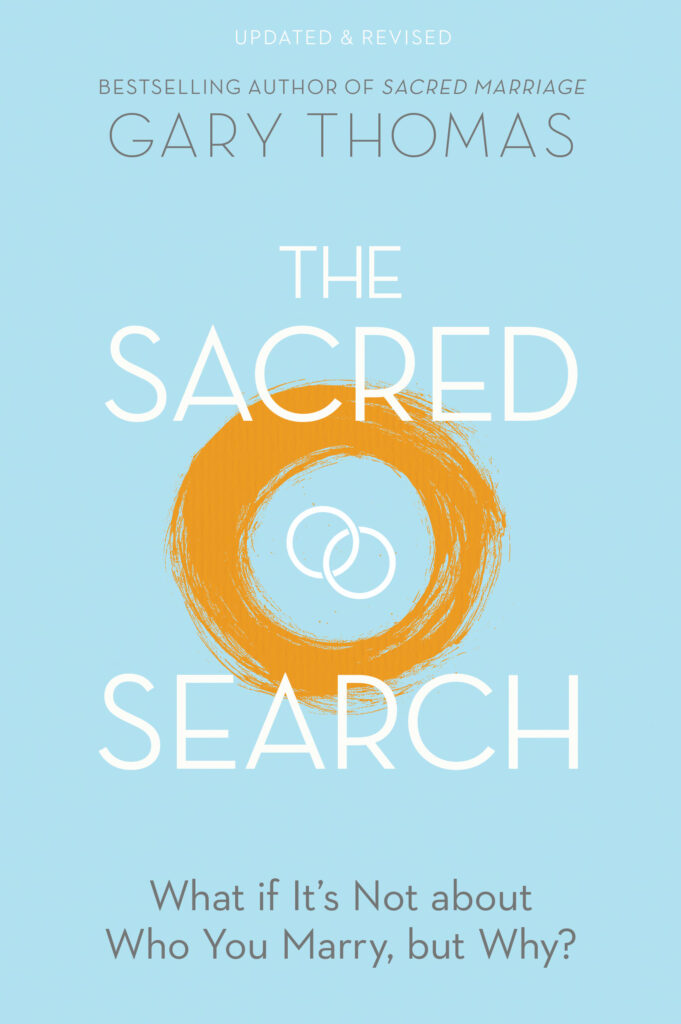
For more on making a wise marital choice, check out my book, The Sacred Search.